
EXERCISE 5e: The Modified Hot/Cold Seat Arrangement
Read the following then answer the four questions that follow below.
It has become customary for the team interpreters to employ a 20-minute switch schedule. Some interpreters follow this schedule strictly which can be problematic, especially when the switches do not follow the natural flow of the session. Here’s a modified switch pattern that might work better for Deaf people as it conforms more naturally to the dynamics of the meeting.
In the chart below, you will see four columns.
The first column is the time of the meeting itself.
The second column is the typical 20-minute switch intervals where it shows when the interpreters would be switching.
The third column is Event which shows what often happens at a meeting where the introductory remarks by the program coordinator are made lasting ten minutes. Then the main presenter has the floor and speaks for 30 minutes from 1:10pm to 1:50. Then the second presenter begins their part at 1:50pm and speaks for 25 minutes until 2:25pm. The meeting concludes with thank you remarks by the program coordinator, lasting five minutes.
The fourth column is the Modified Switch Pattern which shows how interpreters would switch every time there is a different person presenting.
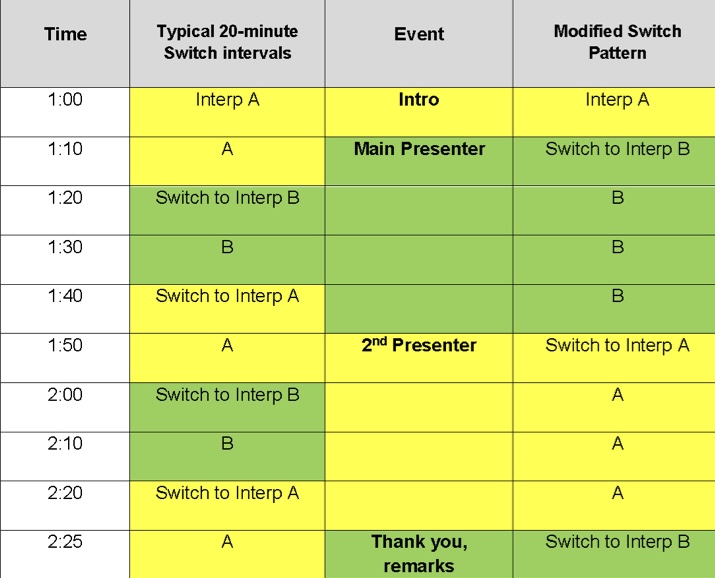
In the modified, naturally-occurring switching arrangement, the switch occurs every time there is a different speaker.
For example, in a typical conference setting, the facilitator would welcome the participants and handle some housekeeping details, taking about five or ten minutes. The facilitator would then turn the floor over to a colleague who would use the next five minutes or so to introduce the keynote presenter. Then the keynote address would commence lasting forty minutes or so. Instead of switching every twenty minutes from start to finish, the interpreters would switch every time a new person comes on the stage.
In this situation, if there are more than two interpreters working at the conference, one interpreter would be responsible for the welcome address, the second interpreter would interpret the introduction, and the third interpreter would do the entire keynote address. This allows for a more natural and smooth transition between interpreters/speakers.